Drop Down MenusCSS Drop Down MenuPure CSS Dropdown Menu
Showing posts with label ACTIVITIES. Show all posts

ON THE WINNERS' LIST!


We are very happy to tell you we are on the winners' list of the national competition Euroscola 2016. We'll be visiting the European Parliament in Strasbourg and will participate with the winners from other EU countries in many activities to understand the job of the EU deputies. 

We'll keep you posted!


Congratulations to the rest of the winners, a big thanks to our teacher (Gabriela Torrens Ansell), and thank you all for your support!


Euromadina (IES Madina Mayurqa, Palma)


The team!

PD: It's a great experience! Join the competition next year!

WE ARE DYN@MIC! SEE THE RESULTS OF OUR SURVEY BELOW!

GUYS, OUR SURVEY IS FINALLY DONE.


It didn't take us much time to get the results from the survey about the EU that we promoted on social media and by whatsapp. Thanks to those people who answered it very fast we could start correcting them the next day (in fact, in less than 24 hours we got more than 100 answers) so now is the time to analyse its results and draw conclusions.


Well, our survey was like a "little exam", which only had 10 short and easy questions. Those questions were about some basic things about the EU (it should be pointed out that there were some questions that were more difficult than others). 


Now let's comment the results!


First of all, we asked for the age of the people who were going to complete the survey. It was necessary to have a balanced survey and we achieved it! 


We were very happy to see that our survey got to different ages, which means older people use new technologies too!                


After that, we asked about the meaning of the acronym "EU" ("UE" in Spanish). We knew it was easy and, obviously, all of the answers were right.


The second question was also easy. It said: "Where are the EU headquarters? And almost 96% of the users answered it correctly. 

Yes, the EU headquarters are in Brussels(Belgium).


So questions number 1 and 2 were easy and almost 100% of the answers were right, but this hasn't happened in all of the questions and one example of this is the next one.


The third question asked about the number of countries that are in the EU nowadays and, in general, most part of the people were right, but there was a meaningful group of people who were mistaken. More than 20 people failed here. 

It's important to remember that today there are 28 countries in the EU. Not more, not less.


We decided to ask people about basic things of the EU so we decided to ask about its flag. It was really easy. Too easy maybe. And obviously, most part of the people did well. 


Nearly everybody knows that the EU's flag is blue and that it has 12 yellow stars on it (which must have the tip up).


One thing that surprised us a lot is that there's a lot of people who don't know much about the EU's anthem. If we have a look at the graphic we see that there's a very big part of the people who were mistaken. Only 48.5% of them answered it correctly. 

Yes, what's today the EU's anthem was composed by Beethoven and its name is "Ode to Joy".  


And what about the next one? It was a complete chaos (but it should be pointed out that this one was probably one of the most difficult questions in the survey). But the most surprising was that they chose to answer "I don't know". 


Don't forget it, Europe's day is on the 9th of May. 


The two following questions were about political things of the EU. For example, in question number 7 we can see that what people had to do was to end that sentence with the correct choice.


Most part of the people answered correctly. This sentence is considered a EU principle: 


"The EU single market allows free movement of persons, goods and services"


Another thing that surprised us was that there is around 40% of the people that don't know that the adhesion of Spain to the EU was signed in 1985 but it was effective in 1986.


It should be pointed out that 36% of the people who answered the survey are under 18 years old, so they hadn't been born yet in 1986. Anyway, we're sure that they have studied it at school at some time. 


Finally, these were the most complicated questions, we know it. If you know the answer, they are not difficult, but if not, and you try to guess it, then it is when you fail.


In question number 9 we asked about the elections to the European Parliament and most part of the people said that they happen every 4 years (like the elections in Spain). This one was a trick question!! 


The European Parliament elections are every 5 years! 

Did you know it? If you didn't answer it correctly it's normal, don't worry. The most important thing is that you must learn from your mistakes, even in this case.


This was our last question, not easy at all but not as difficult as the 9th. It says: "How often does the EU presidency rotates?" 

Luckily, most part of the answers were correct. 

Yes, it happens twice a year. 


We hope you enjoyed this survey. We prepared it with great enthusiasm. If you have got 5 or more than 5 correct answers you have passed this test, but if not, you should read a bit more about the EU and repeat it again another day. You will get better marks next time.


After correcting all of the forms you answered, we started calculating the average of the number of right answers and the result was 6,985/10. The mark is improvable, but it's not a bad mark. 

Congratulations!!!


*If you want to repeat it again and improve your knowlegde on the EU just click here and practise!

How did you do? Send us a tweet!
                      

Sources: 

Everything was taken from our online survey: http://goo.gl/forms/sB5PF1xP1o

WE ARE DYN@MIC! A VISIT TO THE TOWN COUNCIL

Last Friday, we had an amazing meeting with the Mayor of Palma, José Hila and the alderman of mobility, Joan Ferrer, together with some responsibles from his Office, to learn more about the EU Civitas DYN@MO Project and the work that has been done on sustainable mobility in Palma.


We were welcomed very warmly in the meeting room. The Mayor congratulated us on our blog, in which we talk about the 30 years of Spain in the EU, and especially on choosing to talk about the EU project Civitas DYN@MO in Palma, as a lot of good things have been done thanks to this project. 


The Mayor asked us to talk about EUROSCOLA and our project. We explained to them that it is a national school contest to learn more about the EU. We presented the work done on "30 years in the EU, 30 years of news". They were very impressed that we had done it in English too!

After this we wanted to know a bit more about the EU Civitas DYN@MO project in Palma, and they answered all of our questions. We talked about the MobiPalma app (which is fantastic!) and that they are planning on including more services on it. This app has won a prize because it is the first one to integrate different means of transport. For example, you can plan how to get to school combining bus and a public bike. It is great! (You can go to your app store on your phone and download it for free).

There are many more cycling tracks in Palma now (we have one just in front of our school, IES Madina Mayurqa). There are charging stations for electric cars. There are public energy efficient buses. We will write a post including more details!

After the talk, we went to have some pictures taken with all those amazing people. The Mayor also thanked our teacher (Gabriela Torrens) for involving us in the project.


We can only say THANK YOU for that amazing chance to meet you personally and for having shared a bit of your time. 

We hope to see all of you again soon!

Did you like this? Send us a tweet!
                                

WE ARE DYN@MIC! AN ONLINE SURVEY: HOW WELL DO YOU KNOW THE EU?


We wanted to do a survey that could reach to as many people as possible. We wanted to be eco sustainable too, without having to use any paper for it.

So... we used new technologies to write the survey and to share it, not only on this blog, but also by whatsapp, and social networks (Twitter, Facebook...)


This is the link to our survey. If you have read our blog you will know all of the answers. If you haven't, then, maybe you should!


We'll tell you how it goes!


WE ARE DYN@MIC! A CYCLING DAY IN OUR SCHOOL!

As you know, we are studying the impact of the EU project CIVITAS DYN@MO in Palma, so we thought it would be a great idea to get on our bicycles and enjoy some of the cycling tracks the Town Council has built across the city thanks to the EU funding.

Here you can look at the map of the cycling tracks in Palma:

Red de carriles bici de Palma
Source: Palma Town Council


We rode from our school to a beach. It was great! All of the teachers and students followed the indications stated by the Town Council on their site


CIVITAS DYN@MO project logo 
Source: EMT Palma


Did you like it? Send us a tweet!

WE ARE DYN@MIC! INTERVIEWS!

These days we have been doing interviews to our teachers to see if they remember anything from when Spain got in the EU.

We asked people who are now 45-48 years old, and people who are now more than 50 years old. But not all of them wanted to be filmed...

Here goes this one that we made with our teacher Alejandro Benito. He was in his teens when Spain joined the EU and this is what he told us:


Thanks to Alejandro for letting us film him! The interviewer is Jaume, the camera girl is Margalida and the voice over is Raquel.


We also interviewed Michael Cereceda, our Arts teacher:


And our Ethics teacher:


And here you have an audio of an interview with our French teacher.

WE ARE DYN@MIC!: A VISIT TO THE EUROPE DIRECT CENTRE IN PALMA

"The European Union is an invention for people from people"


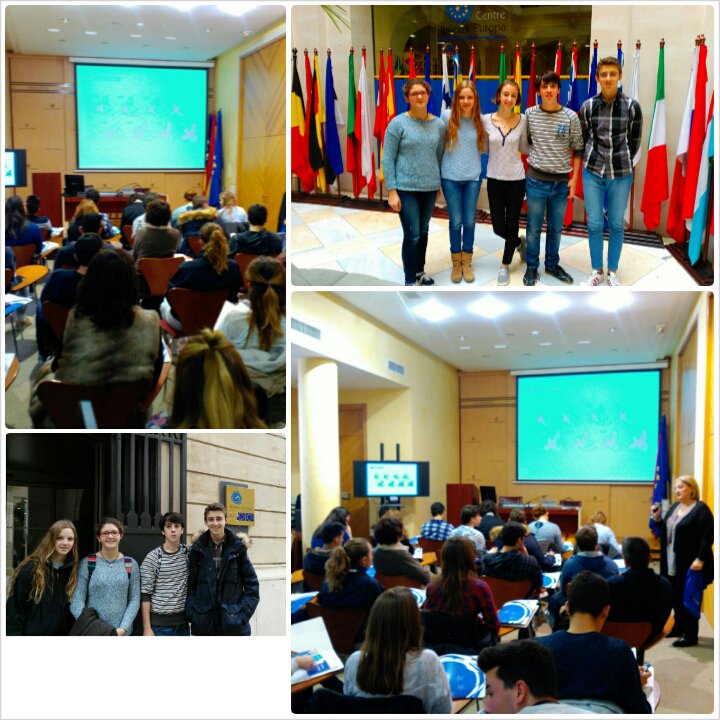
We went to the European Balearic Center ("Centre Balears Europa") to attend a lecture about the European Union. We enjoyed it a lot and we learnt a lot of things.


In this post we are going to explain a few things they talked to us about:

First, they talked about the centre where they work. They told us that it has been 30 years since it was opened. It was at the same time as Spain joined what's now the European Union. It works like this: the European Union opens new centres in every country that gets in the EU so that information for the citizens can flow fast and free. There are more than 500 centres in the EU, and 36 of them are in Spain. They give information about studies, jobs, health systems, laws, as well as information about life in different European countries.
        
They told us that the idea of the EU was because at the end of the Second World War (1945) some problems in Europe were still not solved, and there was a possibility of a Third World War. Because of that, the Treaty of Paris was signed, to use dialogue and no weapons with the objective of preventing a war ever happening againIt was 1951, and the first six countries to join into a European community were France, Italy, West Germany, Belgium, Luxembourg and The Netherlands

The main goals of the EU are: no war, equality and working on solidarity projects. 

According to The Treaty on the European Union, any European country may apply for membership if it respects the democratic values of the EU and is committed to promoting them. The requirements to join the EU are: 
  • having stable institutions to guarantee democracy, the rule of law, human rights and respect for and protection of minorities;
  • having a functioning market economy and the capacity to cope with competition and market forces in the EU;
  • having the ability to take on and implement effectively the obligations of membership, including adherence to the aims of political, economic and monetary union.

There are 24 official languages in the EU. Each time a new country joins the EU, their language is added to the list. Every law has to be written in each language, so each law has been written 24 times. The most spoken language is German, spoken by the 24% of the EU citizens.

Finally, they talked to us about the EU most significant symbols: the EU flag, Europe day, the Euro, the EU motto and the EU anthem. 

The EU flag is made of 12 yellow stars on a blue background, and it symbolizes unity. Europe day is on March 9th. It's that day in commemoration of Schuman's speech on 9 May 1950. The Euro was introduced in 1999, but at the time it was non-physical; in 2002 it became physical. The EU motto is United in diversity,  meaning that, via the EU, Europeans are united in working together for peace and prosperity, and that the many different cultures, traditions and languages in Europe are a positive asset for the continent. And the anthem is the Ode to Joy by Beethoven, a beautiful composition.


This is just a summary of what they explained to us. We are very thankful for their help! 


Here you have the EU anthem and the EU flag:


You can contact them here:

Centro Balears Europa
Conselleria de Comerç, Indústria i Energia

Palau Reial, 17 baixos

07001 Palma

Tel. 971 784460

Twitter: @cbalears


http://www.cbe.es/


Did you like it? Send us a tweet!